
fbpx
viva lily teen

Teens & Menstrual Cups

If you’re new to the world of menstrual cups, you may be wondering if they’re suitable for teens who have just started their periods? YES they are!

When should a teen start using a menstrual cup?
There is no minimum age requirement to start using a menstrual cup, If they’ve started their period then they’re definitely old enough to use a cup! Like all of us, teens might still be getting to know their anatomy so some practice will be needed. When anyone is using a menstrual cup for the first time, they need time to familiarise themselves with the technique to become a period pro. Learning to use a menstrual cup as soon as you get your first period can make menstruation a more positive experience.

Teens should always start with a smaller cup (our Viva Lily size A) and then later if they have a heavy flow they can move on to a bigger cup.

Why should a teen use a menstrual cup?
Starting your period is an awkward time as it is and choosing the right period products can make a world of difference. Menstrual cups are great for teens because they don’t need to worry about leaks, no rushing to the bathroom between classes to change a pad or tampon. And no worrying about how to deal with your period when they’re at the pool. Using a cup can also help them better understand their body and menstrual cycle.

Menstrual cups don’t disrupt the balance of the vagina’s pH because instead of absorbing fluids in the vagina the way tampons do, menstrual cups simply catch menstrual flow. This means that there is no dryness, less irritation and less risk of infections. Plus, many menstrual cup users report shorter periods and less cramping!

These are the main reasons why a menstrual cup is a great solution for teenagers.

Are menstrual cups safe for teens to use?
A lot of girls are hesitant to use tampons because of their association with toxic shock syndrome (TSS). This is extremely rare when using menstrual cups!

Does a menstrual cup break the hymen of a virgin?
The hymen consists of a thin tissue which partially covers the entrance of the vagina. The hymen can be torn in many activities such as sports and over time it dissolves through discharge, hormones or sexual intercourse. Inserting menstrual products such as cups or tampons can also tear the hymen but we (and many other cultures) believe that the presence of the hymen is not a sign of virginity. A virgin is a person who has not yet had sex and using menstrual products does not change that.

What are the other benefits of teens using menstrual cups?
It sparks conversation about the environmental impacts of pads and tampons and enables teens to make more eco-friendly decisions when choosing period care products. It also encourages them to think beyond their own comfort and consider the impact their choices have on a global scale.

Top Tips:

  • We always recommend that mom use the cup first so she can help answer any questions their teen daughter may have.
  • Try the cup for the first time right after boiling it (let it cool first) as this will make the cup a bit softer.
  • Wet the cup or use some water-based lubricant for extra help.
  • Be patient and give your body some time to get used to this new thing you’re trying. It’s normal for it to take a few cycles before you’re perfectly comfortable inserting and removing your cup.
  • Use the punch-down (or push down) fold because it creates a small insertion point.
  • Do a practice run before you actually need to use your cup.

Our final tip for helping your daughter start her period life with confidence:
Help her understand her options. Everyone is different and it’s important they find the right menstrual care products for their body.

periods dad viva lily

Periods 101 For Dads

Hey dads – are you ready for your daughter’s first period?
Historically this has been a discussion left to mom but we believe it’s time for dads to get involved and be part of the conversation.

“Let’s not leave Dads out of the bloody conversation.” – Michael Sheen. Actor, Activist, Dad.

5 tips on how to have positive conversations with your kids about periods –

1.Know the basics of menstruation.
Every month a woman’s body prepares to have a baby by releasing an egg. The womb develops a thick lining that has everything a foetus would need to develop. When the egg is not fertilised the lining is shed out of the body as a period.

2.Remember that periods are different for everyone.
Most women menstruate between the ages of about 12 and 50. Each period lasts about 3-7 days but it can take a couple of years for periods to settle into a pattern, so don’t be concerned if teenagers have irregular periods.

3.When to talk to your kids about menstruation.
There is no perfect moment to have the discussion. Talk about difficult topics early and often, rather than having one big conversation all at once. When periods come up in conversation, you walk past some tampons in the shop, or when you’re watching a movie which brings up PMS – use these moments to chat. Schools cover puberty when kids are in their last year of primary school (aged 10/11). For some girls, this is too late as research shows that 15% of girls don’t know what’s happening when they start their period. Start talking to your daughter when she is 8.

4.Teach your daughter:

  1. Periods are normal.
  2. Speak up – periods don’t need to be hidden and they’re nothing to be ashamed of.
  3. Get help – if they hurt a lot go and see a doctor to be safe.

5.Teach your son:

  1. Periods are not gross.
  2. Be kind and don’t tease girls.
  3. It’s ok to ask questions.

Now that you’ve got the talk covered, what else do you need in preparation for your daughter’s first period? Here’s a quick checklist –
1.Buy some pads and put them somewhere easy to access.
2.Extra supplies of dark coloured pants is a great idea.
3.Make your bathroom period friendly by putting a small bin next to the toilet.
4.Create a discrete starter-pack for her school bag in case she starts there.

Lastly, when buying period products, you might feel overwhelmed at the selection available. There are no right or wrong products and your daughter will gradually learn what works best for her. Here are a few basics to know when making your choice on what to buy –

1.Pads/Sanitary Towels: These are usually the best products to use when they first start their periods because they’re the easiest! They simply stick inside your pants and they come in lots of shapes and sizes and are made of different materials.
2.Tampons: These go inside the vagina and can be quite difficult to insert at first but some come with an applicator to make the process easier. Tampons should never be worn for more than 8 hours as there is a small risk of Toxic Shock Syndrome.
3.Menstrual Cups: These sit inside the vagina to collect blood rather than absorb it. They are reusable over many years making them cheaper in the long run, and much better for the environment. They’re a great choice for exercise and swimming.

So dad, it’s time to help normalise menstruation by taking part in the conversation.
Most importantly… just be the dad she knows and loves – nothing has changed!

MENSTRUAL CUP FIRST TIMER?

My Personal Experience

“When I first learned about the menstrual cup, I was surprised that I hadn’t come across them sooner as they are not a new concept. As someone who constantly embraces new medical developments and anything that can better assist us with taking care of our bodies, I was instantly intrigued by the cup and wanted to try it out. I started to do a lot of research and was quickly convinced that this was a NO BRAINER alternative to pads and tampons. I had read countless positive reviews and benefits of the cup and I was excited to try mine out for the first time.

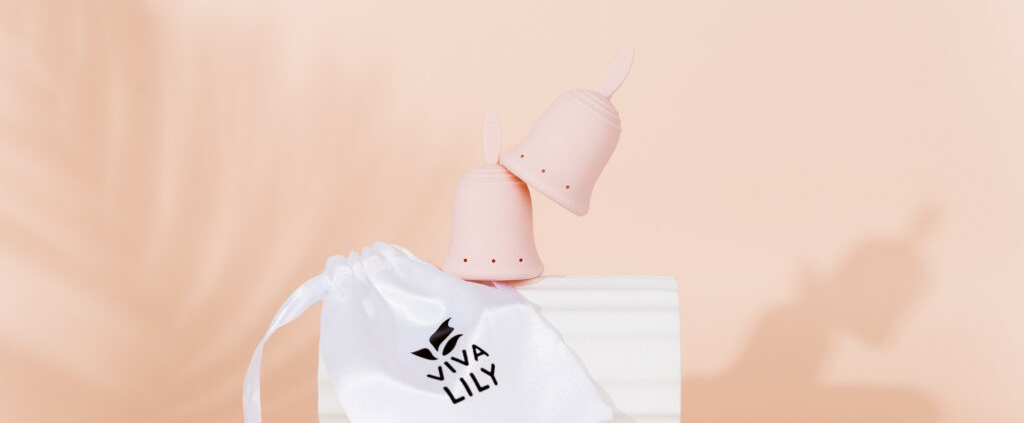
I decided on a small cup because I have a light flow and the 2 options offered by Viva Lily are:
Size A (Pink): recommended for younger girls and a light to average flow.
Size B (Blue): recommended for a medium to heavy flow.
Some reviews stated that women were intimidated by the size of the cup but when I first saw the cup I actually thought it was really small – maybe TOO small? Then I started Googling how to measure your cervix and I started feeling around to see where mine was located. Not as low as I had thought – what if the cup gets stuck? Then I read that it’s not uncommon for a cup to get stuck and you may need to get a friend to help you pull it out! Suddenly, I wasn’t so excited!

First Attempt:
I wet the cup with a little tap water as I had read this made it easier to insert. I decided to use the “punch down” fold as this seemed the most popular. I folded it and up it went. Once inserted you are meant to tug on the stem so that the cup ‘pops’ open to form a seal and nestles comfortably inside of you. Mine did not pop open! I moved my finger around the cup and tried to push out any air pockets, nope! I removed it and tried again only to have the cup go too far up and the panic of ‘losing my cup’ set in so I pulled it out again.

Back to Google – “You might have a tilted cervix”, “Pelvic organ prolapse can limit your menstrual cup’s ability to open”. There is SO much information on the interweb – so I went back to the basics and read some troubleshooting tips. One suggestion was to “Rotate the cup 360°” but this didn’t work so I landed on doing some kegel squeezes until I felt a little ‘pop’. Yay! I also know from using a Nuvaring (removable contraceptive device) that anything in the vaginal canal does move and shift until it finds a ‘comfy’ spot and I did notice after a while that the cup had found somewhere comfortable to nestle. Success!
Note – I did this practise round before I actually came on my period – I would advise doing this as you really don’t want to be fishing around in there once you are on your cycle.
But in doing this I didn’t realise that your cervix is a lot higher up than when you are ovulating and it drops down lower.

Round 2: This is not a drill!
A day or two later it was time to use my cup FOR REAL! But, now that I was more comfortable with how to insert the cup, there was no anxiety around that task, but rather removing it without ‘spillage.’ Luckily I work from home so I was able to check for leaks whenever I needed to and I’m delighted to report that there were none! At the end of the day it was time to empty the cup. I squeezed the cup to break the seal (you can’t just tug and pull it out as it really does create a strong seal) and slowly started to pull it out. It feels a LOT bigger than it did going up – eek! I immediately tensed up which made everything tighter and didn’t help the situation. Relax, deep breaths… and just like that it didn’t feel so big and out it came with a little flow inside. No mess and much easier than I thought. I emptied the cup, gave it a little rinse in the basin and put it back in for the overnight test.

12 hours later:
Again, no leaks during the night but I was eager to empty the cup first thing in the morning as I was worried it would overflow! I woke up with the birds and removed my cup, which to my surprise was only a quarter full. I clearly overestimated how much fluid I lose each month and that is one of the unexpected benefits I found of using the cup. It makes you far more aware of how your body works and we all know that knowledge is power. I also enjoyed the sensation-free experience of wearing the cup – no more trying to dodge peeing on a string or having to change your tampon every time you go to the bathroom to try keep things dry. With the cup, you don’t even know it’s there and can go about your business like you would if you weren’t menstruating. This is especially useful if you are a swimmer or someone that enjoys activities that require you to be away from a bathroom for extended time periods (excuse the pun).

Conclusion:
Change is scary. New is intimidating. But we need to try and give ourselves the opportunity to potentially better the way we take care of our bodies. It’s not going to be easy the first time but be patient and over time you will become cup confident.”

It’s time to change. Period.
Viva Lily’s premium bell shaped menstrual cup is made from medical grade silicone that’s super soft and flexible, allowing you the freedom to MOVE. The Viva Lily cup is the only menstrual cup to have been researched, trialed and published in the South African Medical Journal for it’s uptake, safety and acceptability in Sub Saharan Africa.

FREE DELIVERY ON ALL PURCHASES